On Being AN Atthowe Art Handler
I work in someone else’s dream. Scott Atthowe passed 8 months before I started working at the company he started. I never met him, but in the year and a half that I’ve spent here, I’ve become familiar with this myth of a man through the people he left behind - my managers, veteran staff, clients and tradesmen who worked with him throughout the years.
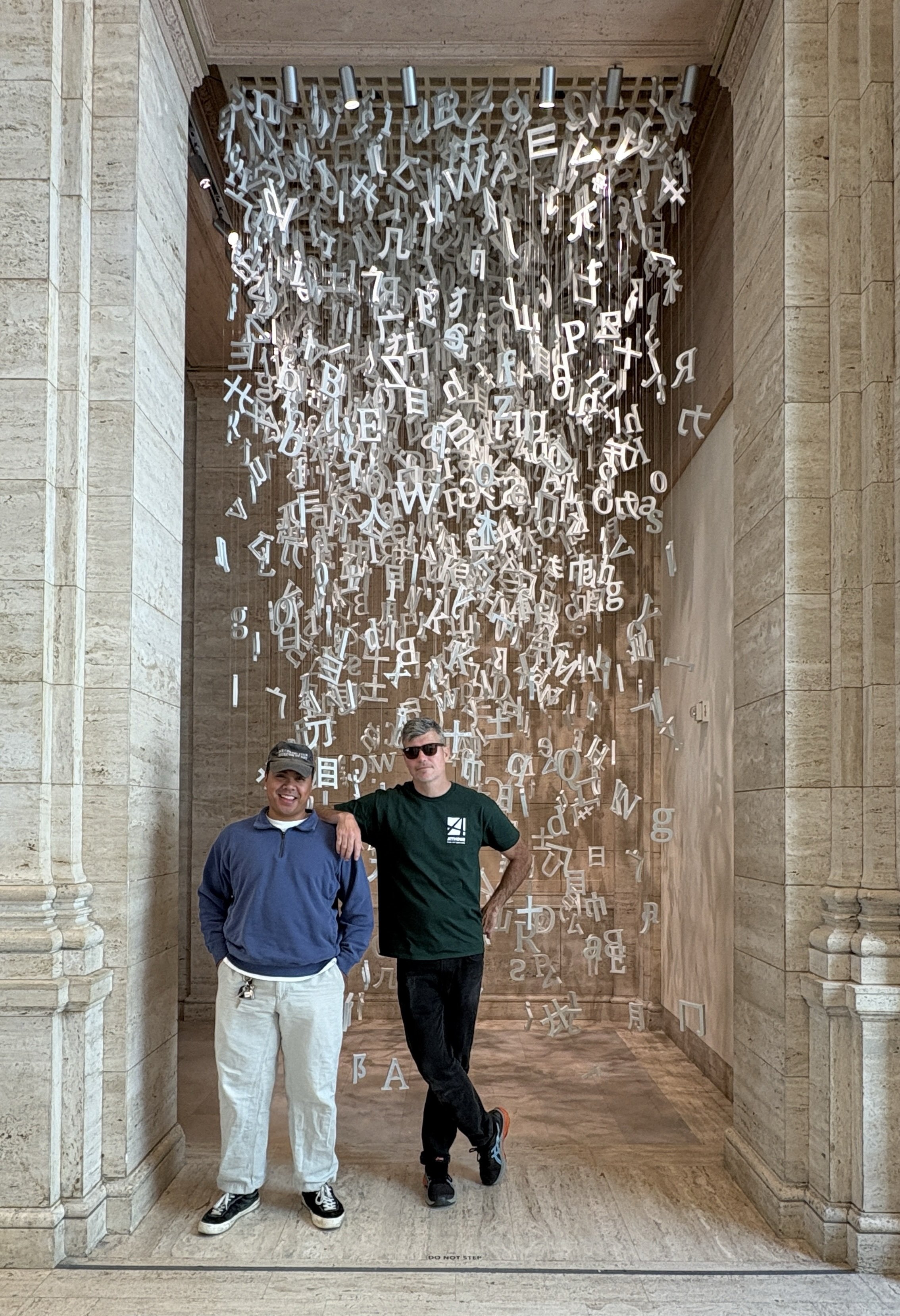
Adam and Darius pictured at the Asian Art Museum, two of the Atthowe art handlers who installed Collected Letters by Liu Jianhua
Eccentric, unconventional, punk rock; I’m not the first person to describe this company (or Scott himself) this way. The Bay Area’s dominant business models are infamously structured around maximizing returns for a single owner, so suddenly running a worker-owned cooperative becomes even more difficult to do. Somehow, Atthowe Fine Arts Services does it, and I believe it’s because of its people - people who are asked to do more than an average employee at your average billionaire-owned company: care. It’s quite an experience jumping headfirst into someone’s legacy unfolding in real time. After all this is just my day job.
A good portion of my year consisted of 32 feet of corten steel, 1,600 porcelain letters, and a quarter-mile of neon. Night after night, week into extended week, knot after knot of monofilament, my most practiced skill became working well with my coworkers.
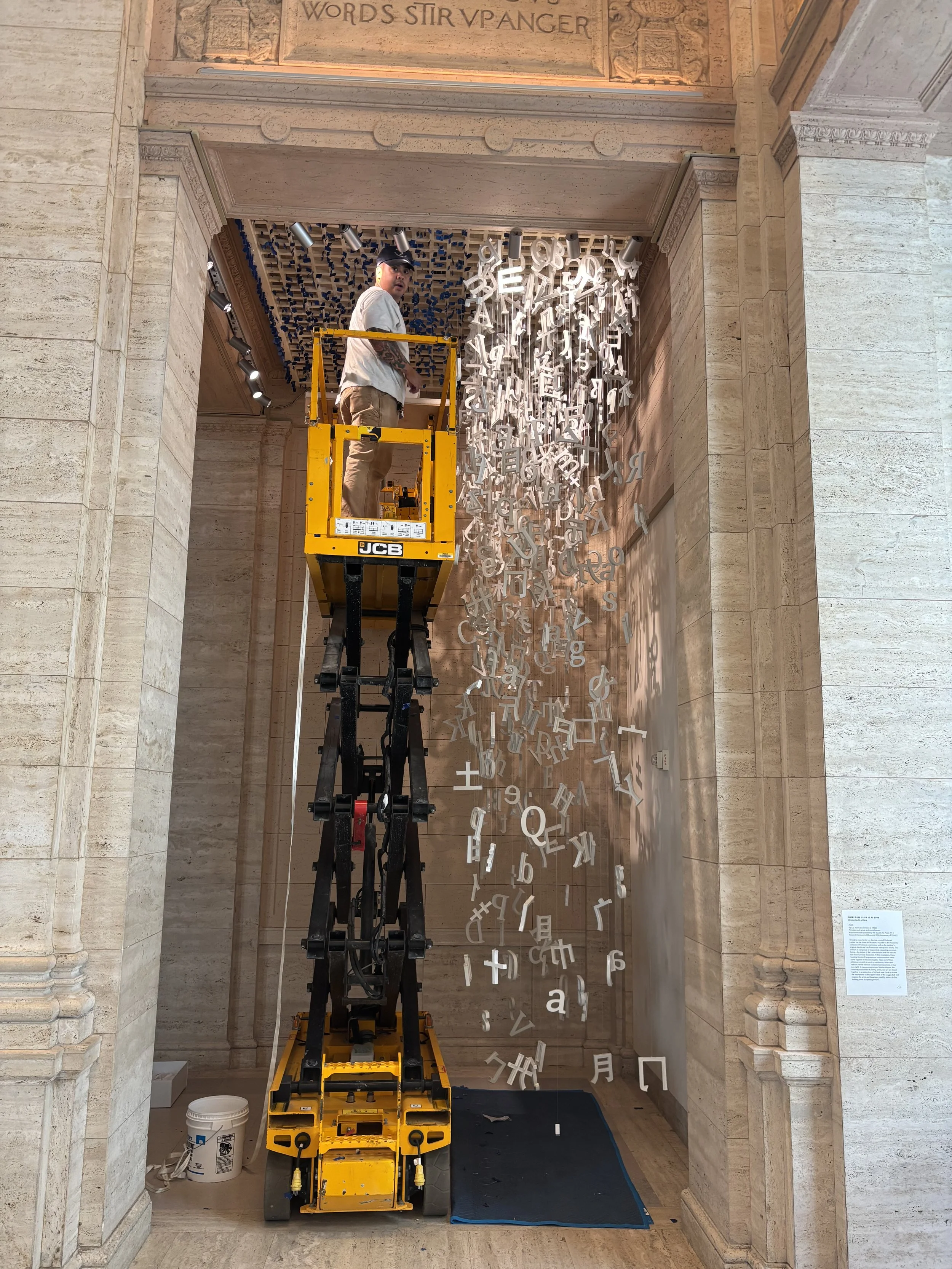
Adam getting to know the ceiling of the Asian Art Museum
I loved waxing about Deconstructionist Theory in school, but unfortunately citing Derrida can’t help you operate a telehandler, or communicate clear rigging instructions to five over-caffeinated art-handlers with egos. Anyone who works on a crew will tell you that if the vibes are off, the chances of mistakes increase. I was never the best athlete in college but I learned how to see big-picture, rile up my teammates, and soothe tensions by redirecting us back to the objective of getting it done. Ostensibly, a better third-base coach than designated hitter.
We worked til the sun came up on Andrea Bowers’ We’ve Got to Give Them Hope at SFO, trekked through red mud raising two towering Jaume Plensa sculptures, and spent more time on the Beaux-arts ceiling of the Asian Art Museum than its floor while hanging the Collected Letters of Liu Jianhua. From a professional standpoint, working on these projects has helped me develop my hard skills as an art technician and heavy machine operator, develop my communication and leadership skills, and has improved my overall work-ethic. Though I doubt that those opportunities are what makes Atthowe particularly appealing to its current or future employees. For me, to work at Atthowe means to work together; to quite literally cooperate. Very closely to one another for long periods of time. To carry heavy weight, both physical and at times, emotional. The kind of labor that can’t be outsourced no matter how agentic the system. Being a part of a co-op that prides itself on employing artists, and functions similarly to the art-making process: complex problem solving, a healthy amount of risk, and sensitive execution.
Those who knew Scott Atthowe really care about the company he left behind, and the members who inherit it. As one of the younger employees it’s rare to see this at a job. Maybe it’s because of its wonky, non-hierarchical structure, or its employees’ eccentricities and artistic styles, or perhaps it’s just a natural consequence of cooperative governance. There are clearly more empirical ways to run a business, with less personal stake involved and caring about the place you work is truly optional, but it certainly makes clocking in easier.